

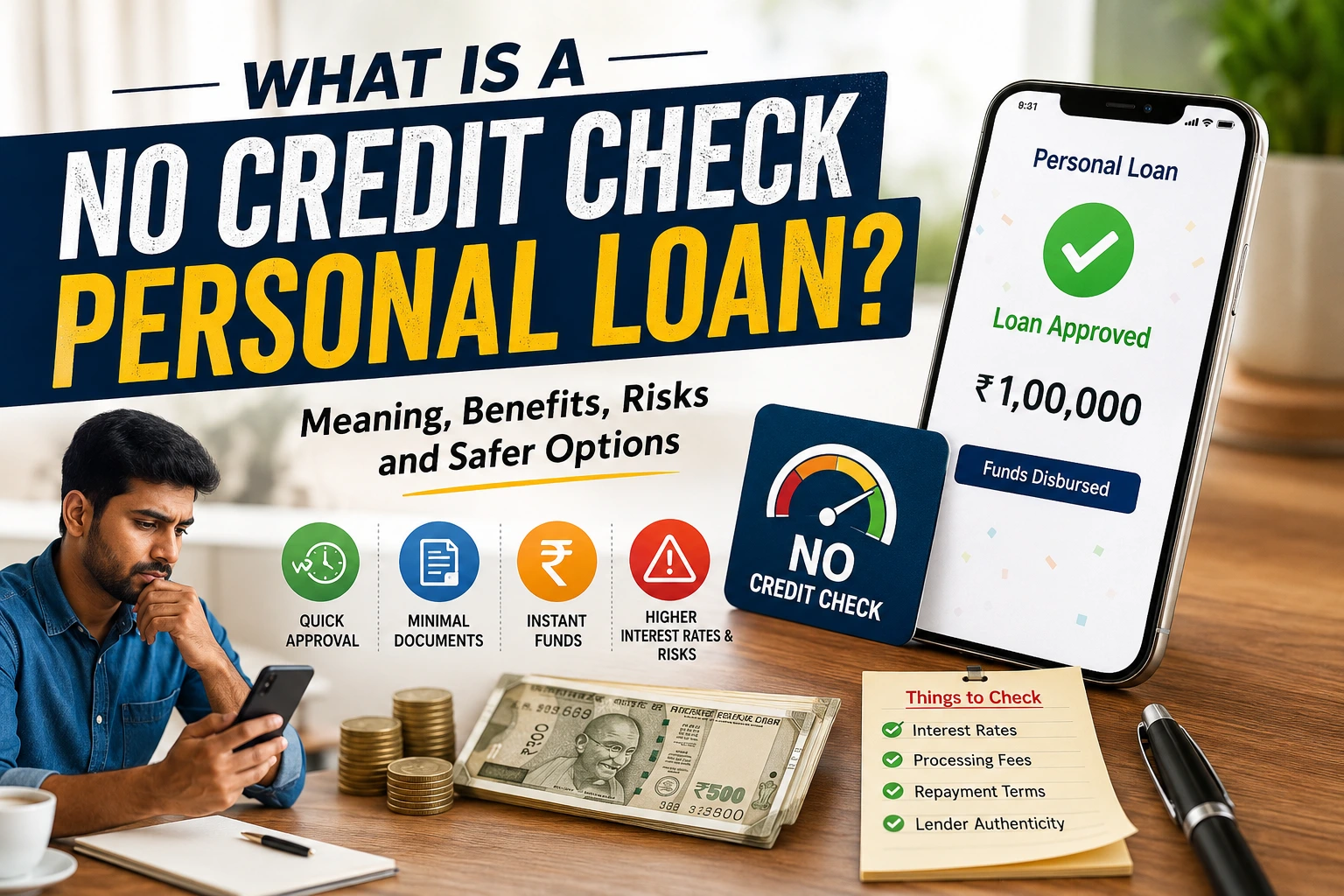
Those with a bad credit score or little experience borrowing from financial institutions may find it hard to obtain a conventional personal loan. In such situations, they might end up looking for an online no-credit-check personal loan , which would help them get money without being affected by their previous creditworthiness.
Even though it is a simple phrase, people tend to confuse themselves with it. No credit check doesn’t mean that the lender will give you money without verifying your financial standing. The lender can always verify your income, employment status, identity, banking activities, and outstanding debts.
Such a loan can give you easy access to cash; however, it might be associated with high costs, short repayment periods, and the likelihood of ending up in fraud through misleading loan apps. Thus, the applicant must know all the terms of the loan before providing his/her documents.
What Is a No Credit Check Personal Loan?
A personal loan without a credit check is often referred to as a type of loan where the lender does not use the conventional credit bureau report as the primary tool for assessing the borrower’s application.
Rather than depending only on the credit score, the lender might analyse other factors like:
- Monthly salary or business income
- Employment stability
- Bank-account activity
- Existing EMIs and financial obligations
- Regular cash flow
- Residential and identity details
- Overall repayment capacity
But “no credit check” should not be mistaken for “no assessment”. In accordance with the RBI’s Digital Lending Directions, 2025, regulated lenders must gather information on the borrower’s economic profile prior to granting any digital loan, at a minimum including the age, profession, and income level of the borrower.
Hence, a genuine lending institution will still need to determine if the borrower can repay the loan.
Why Is a Credit Score Important for a Personal Loan?
It is the numerical value ranging between 300 and 900 and indicates how good a borrower’s creditworthiness based on past borrowing and repayments has been.
Credit scores and credit histories, in addition to income, are used by banks and financial institutions while considering loan applications. The RBI financial awareness information also suggests that all other factors being equal, a borrower with a better credit score should be able to get a lower interest rate.
Through credit scores, lenders attempt to determine the probability of late payments or defaults on repayments. CIBIL also provides lenders a Personal Loan Score for insight into the personal-loan behavior of the applicant.
A person who has had no loans or credit cards before would not have sufficient data on his/her credit report. This is called being ‘new to credit’ and differs from low credit score due to missed or defaulted repayments.
Does No Credit Check Mean Guaranteed Approval?
No. A personal loan without a CIBIL score check does not mean that approval is guaranteed.
A lender may reject an application for several reasons, including:
- Insufficient or irregular income
- Unstable employment
- Excessive existing EMIs
- Incorrect information in the application
- Unsuccessful identity verification
- Unusual bank-account transactions
- Inability to meet the lender’s age or location requirements
- A requested amount that is too high compared with income
Any advertising that involves terms like “100% approved loan,” “loan for everybody,” or “loan without any checks” needs to be approached cautiously when considering any Loan Offer . Any good lending organisation will evaluate the borrower’s capacity to pay back and decide whether to accept, reject, or change an application as per its lending policy.Any advertising that involves terms like “100% approved loan,” “loan for everybody,” or “loan without any checks” needs to be approached cautiously. Any good lending organisation will evaluate the borrower’s capacity to pay back and decide whether to accept, reject, or change an application as per its lending policy.
How Does a No Credit Check Personal Loan Work?
While the process may differ from lender to lender, it normally follows the sequence below.
1. Online Application
The prospective borrower fills in an online application form with personal, employment, and financial information
2. Identification Authentication
The bank performs KYC verification in order to verify the identity and address of the borrower. KYC is described by the RBI as the procedure whereby the regulated entity collects and validates the information regarding the identity and the address of the customer.
3. Assessment of Income and Bank Account
The lender can assess the salary credits, bank account details, business income, cash flow, and repayment obligation.
4. Eligibility
The application is evaluated based on the lender’s criteria. The lender might grant a lower amount or a different repayment period.
5. Loan Offer
The borrower receives information about the loan amount, interest rate, repayment period, EMI, fees, and other terms.
6. Acceptance and Disbursal of Loan Amount
When the loan agreement is accepted by the borrower, the loan amount is credited to the borrower’s bank account.
As per RBI’s Digital Lending Directions, the digital loan should be disbursed to the borrower’s bank account barring certain regulatory exceptions. The repayments must usually come directly from the borrower to the regulated entity.
Who Can Seek Loans without the Usual Credit Check?
Such loans can be sought by:
- First-time borrowers who lack a credit rating
- Borrowers who have a low credit score
- Individuals who are self-employed with irregular income documents
- Individuals who were previously turned down for normal loan applications
- Individuals having an immediate financial expense
- Individuals who seek lenders who utilise alternative financial information
But urgency should not deter individuals from making a cost comparison. The loan can be very hard to pay back if it has a high interest rate, short term or even has multiple charges.
Common Eligibility Requirements
Each loan provider has its own eligibility criteria. An individual can be expected to fulfil certain criteria such as:
- Age limit
- Citizenship of India
- Monthly salary limit
- Employment/Business stability
- Having an active bank account
- A valid cell phone number
- Proper address
- Debt ratio
Basic criteria fulfilment does not ensure eligibility. It is entirely based on the lender’s discretion.
Documents That May Be Required
The documentation requirements by the lender could be as follows:
- PAN card
- Proof of Aadhaar or any other official identification
- Proof of address
- Recent salary slips
- Bank statements
- Employee ID card
- IT returns
- Documents of business registration
- Photograph of the applicant in passport size
KYC guidelines provided by the RBI have many officially accepted identification documents like passport, driving license, proof of possession of Aadhaar number and voter ID. In some cases, even PAN card or Form 60 might be needed.
The actual documentation will vary based on whether the individual is a salaried employee or a self-employed person.
Click Here : to more information about – Navi: A Trusted Digital Loan Solution
Interest Rates, APR, and Other Charges
The cost is one of the most critical aspects to consider in no credit check loans.
In light of the absence of information from the lender regarding past repayment behaviour of the applicant, the lender can mitigate its perception of the risk by providing:
- Higher interest rate
- Lower loan amount
- Shorter repayment period
- Stringent repayment terms
The borrower should not look at just the advertised interest rate. Some of the costs that might arise are:
- Processing fees
- Documentation fees
- Taxes applicable
- Late payment fees
- Penalty fees
- Foreclosure/Pre-payment fees
- Service fees
It is necessary for the borrower to look at the Annual Percentage Rate (APR), which is a more comprehensive measure of the annualised cost of the loan compared to the interest rate itself.
Under RBI’s Digital Lending Directions, there is a need for the regulated lender to provide a Key Fact Statement, which should include details such as the loan amount, loan tenure, APR, monthly repayment and penalties.
No Credit Check vs Soft Check vs Traditional Credit Check
| Assessment type | How it generally works | Information considered |
| No traditional credit check | The lender may not rely primarily on a regular bureau inquiry | Income, occupation, bank activity and repayment capacity |
| Limited or soft assessment | The lender may conduct a preliminary eligibility review | Basic financial and credit-related details |
| Traditional credit assessment | The lender reviews a credit report and score as part of underwriting | Credit history, repayment behaviour, accounts and inquiries |
The terminology used by lenders can differ. Applicants should ask whether the lender will obtain a credit report, whether the application will be reported to a credit bureau and whether repayment activity will affect their credit history.
Benefits of No Credit Check Personal Loans
A loan assessed through alternative information may offer certain benefits.
Access for New-to-Credit Applicants
People without a long borrowing history may get an opportunity to qualify based on income and financial behaviour.
Digital Application Process
Some lenders allow applicants to submit forms, complete KYC, and upload documents online.
Alternative Eligibility Assessment
The lender may consider bank transactions, employment stability and cash flow instead of relying only on a credit score.
Potentially Faster Decisions
Automated systems may reduce the time required to review straightforward applications. However, applicants should not assume that every application will receive instant approval or same-day disbursal.
Risks and Disadvantages
The convenience of a bad credit personal loan can come with important risks.
Higher Borrowing Cost
High interest and additional charges may significantly increase the total amount that must be repaid.
Short Repayment Period
A shorter tenure can create a larger monthly repayment burden, even when the loan amount is small.
Risk of a Debt Cycle
A borrower who cannot repay the first loan may take another loan to cover the EMI. Repeated borrowing can make the financial situation more difficult.
Misleading Loan Applications
Some applications may hide the name of the actual bank or NBFC, display incomplete charges or use aggressive marketing.
Privacy Concerns
The applicants should beware of applications that request unnecessary access to contacts, call history, pictures or files.
According to the RBI’s Digital Lending Directions 2025, collection of data from lenders and the digital lending partners is supposed to be based on need and have the consent of the borrower. It is not advisable for the digital lending applications to have access to such resources like contact lists, call history, files or media.
Negative Credit Impact
Even when the original approval did not involve a traditional credit check, the loan may still be reported to credit-information companies. Late payments or defaults can affect future borrowing opportunities.
How to Identify a Legitimate Digital Lender
Before applying, take the following precautions:
- Identify the bank or NBFC providing the loan.
- Verify that the loan app is connected to a regulated lender.
- Read the Key Fact Statement before accepting the loan.
- Check the APR, EMI, tenure and total repayment amount.
- Review processing fees and penal charges.
- Read the privacy policy and app permissions.
- Confirm the customer-care and grievance details.
- Avoid transferring an advance fee to “unlock” approval.
- Never share your OTP, PIN, password or card security code.
- Keep copies of the sanction letter and repayment receipts.
The lender’s website should clearly identify its digital lending products, associated lending-service providers, customer-care system, grievance mechanism and privacy policies.
A genuine loan app should also make it clear which regulated entity is actually lending the money. The app itself may be only a service provider and not the lender.
How to Apply for a No Credit Check Personal Loan Online
Step 1: Decide How Much You Need
Calculate the actual expense and avoid borrowing more than necessary.
Step 2: Check Your Repayment Capacity
Estimate the EMI and ensure that it can be managed alongside rent, bills, existing EMIs and regular household expenses.
Step 3: Compare Regulated Lenders
Compare the APR, total repayment amount, tenure, fees and customer-service details instead of selecting the first advertisement.
Step 4: Prepare Your Documents
Keep identity, address, income and bank documents ready.
Step 5: Complete the Application Honestly
Enter accurate income, employment and contact information. Incorrect information may delay or cancel the application.
Step 6: Review the Key Fact Statement
Check the approved amount, amount actually credited after deductions, EMI, APR, due dates and late-payment conditions.
Step 7: Read the Agreement
Do not accept the loan until you understand the repayment schedule, fees, data policy and default consequences.
Step 8: Receive the Funds
After approval and agreement execution, the regulated lender should transfer the approved amount to the designated bank account.
Step 9: Save All Records
Keep the agreement, KFS, transaction details, repayment schedule and customer-support information.
Cooling-Off Period for Digital Loans
In the Digital Lending Guidelines, the RBI gives an initial cooling off period for digital loans. In the cooling off period, the borrower is entitled to have an exit route from the digital loan by paying back the total principal amount and APR without any penalty. The minimum cooling off period is one day but can vary depending on the lender’s policy, which is longer. A one-time processing fee can be charged to the borrower provided that it had been disclosed in the KFS.
The above is an opportunity for the borrower to reconsider their decision about the digital loan immediately after taking the loan.
How to Repay the Loan Responsibly
Create a repayment plan before accepting the loan.
- Include the EMI in your monthly budget.
- Maintain sufficient funds before the due date.
- Use automatic payments when appropriate.
- Avoid taking another expensive loan to pay the current EMI.
- Pay more than the required amount only after checking prepayment conditions.
- Contact the lender early if you expect repayment difficulty.
- Keep receipts and account statements.
- Check your credit report for accurate reporting.
RBI advises borrowers to borrow within their means, avoid missing repayment instalments and maintain timely repayment behaviour. Individuals are also entitled to one free full credit report, including their credit score, from each credit-information company once per calendar year under the applicable framework.
Safer Alternatives to No Credit Check Loans
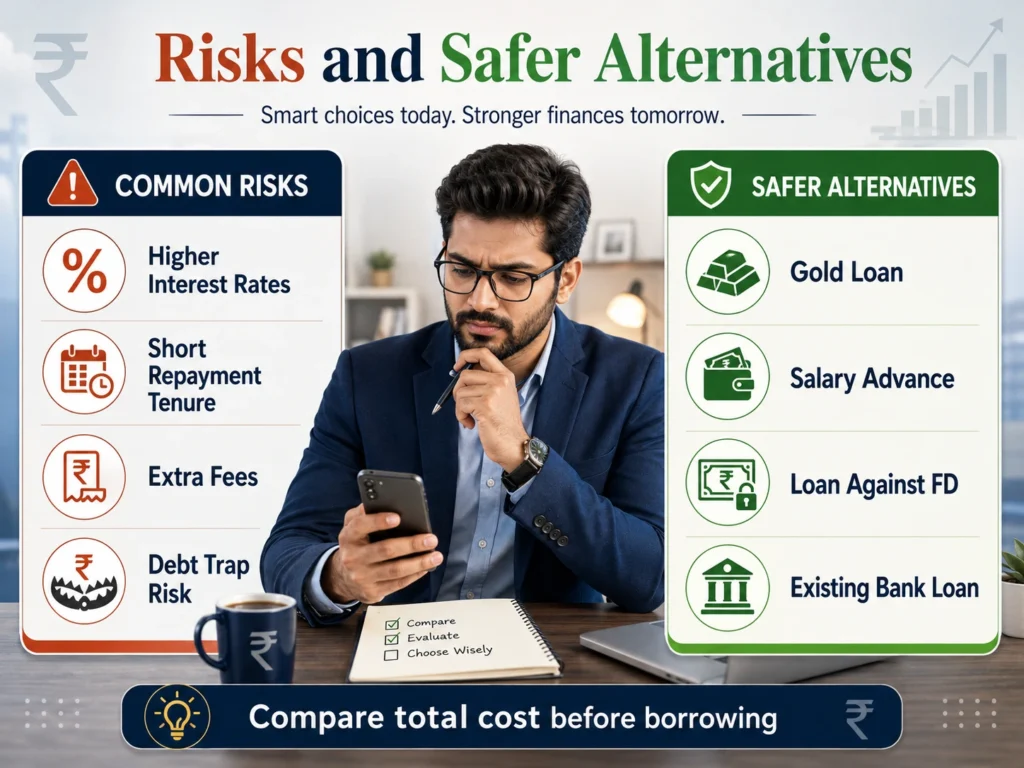
Before accepting an expensive unsecured loan, consider whether another option may be more suitable.
Secured Loan Against a Fixed Deposit
A loan backed by a fixed deposit may carry a lower risk for the lender and could offer more favourable terms.
Gold Loan
Applicants with eligible gold assets may consider a gold-backed loan from a regulated bank or NBFC.
Salary Advance
Some employers or salary-linked financial providers offer an advance against future salary.
Loan With a Co-Applicant
An eligible co-applicant with stable income and a stronger credit profile may improve approval chances, although both applicants can become responsible for repayment.
Smaller Loan From an Existing Bank
An existing banking relationship may help the lender evaluate regular income and account activity.
Family Assistance
Borrowing from a trusted family member may avoid high interest, but the amount, repayment date and expectations should be documented clearly.
Emergency Savings
Using available emergency savings can sometimes be less expensive than paying loan interest and fees.
Improve Your Credit Before Applying
When the expense is not urgent, improving the credit profile may help the applicant qualify for better options later.
How to Improve Your Chances of Getting a Personal Loan
Applicants can improve their financial profile by:
- Paying existing EMIs and card bills on time
- Reducing overdue balances
- Correcting errors in their credit report
- Avoiding multiple applications within a short period
- Maintaining regular salary or business deposits
- Applying for a realistic amount
- Reducing unnecessary monthly debt
- Keeping income documents updated
- Considering a suitable co-applicant
Improving a credit profile takes time. Avoid companies that promise to remove genuine defaults or increase a credit score immediately in exchange for a fee.
A no credit check personal loan may appear useful to people with a low credit score or no previous credit history. However, the term does not mean that the lender will provide money without verifying income, identity or repayment capacity.
These loans can include higher costs, shorter repayment periods and stricter conditions. Applicants should avoid advertisements promising guaranteed approval and should apply only through a clearly identified bank or NBFC.
Before accepting any loan, review the Key Fact Statement, compare the APR and total repayment amount, verify the lender, examine the app’s permissions and ensure that the EMI fits comfortably within your budget. When possible, compare secured loans, salary advances and other alternatives before selecting an expensive short-term loan.
Click Here : to more information about – How to Apply for a Paytm Personal Loan Online
FAQ
The chances of a person who has not used credit before being able to receive credit through income, employment or even through banking transactions may still exist. It all depends on the lending institution’s policy and the person’s ability to repay.
No. Credit assessment and KYC are different processes. A regulated lender is still required to verify the applicant’s identity and other necessary details.
No. No responsible lender can guarantee approval before reviewing the application and financial information.
They may be more expensive when the lender considers the application higher risk. Applicants should compare the APR, total repayment amount and all disclosed fees.
It may. A loan can be reported to a credit-information company even when a traditional credit inquiry was not the main approval method. Missed payments can negatively affect future credit eligibility.




Leave a Reply