
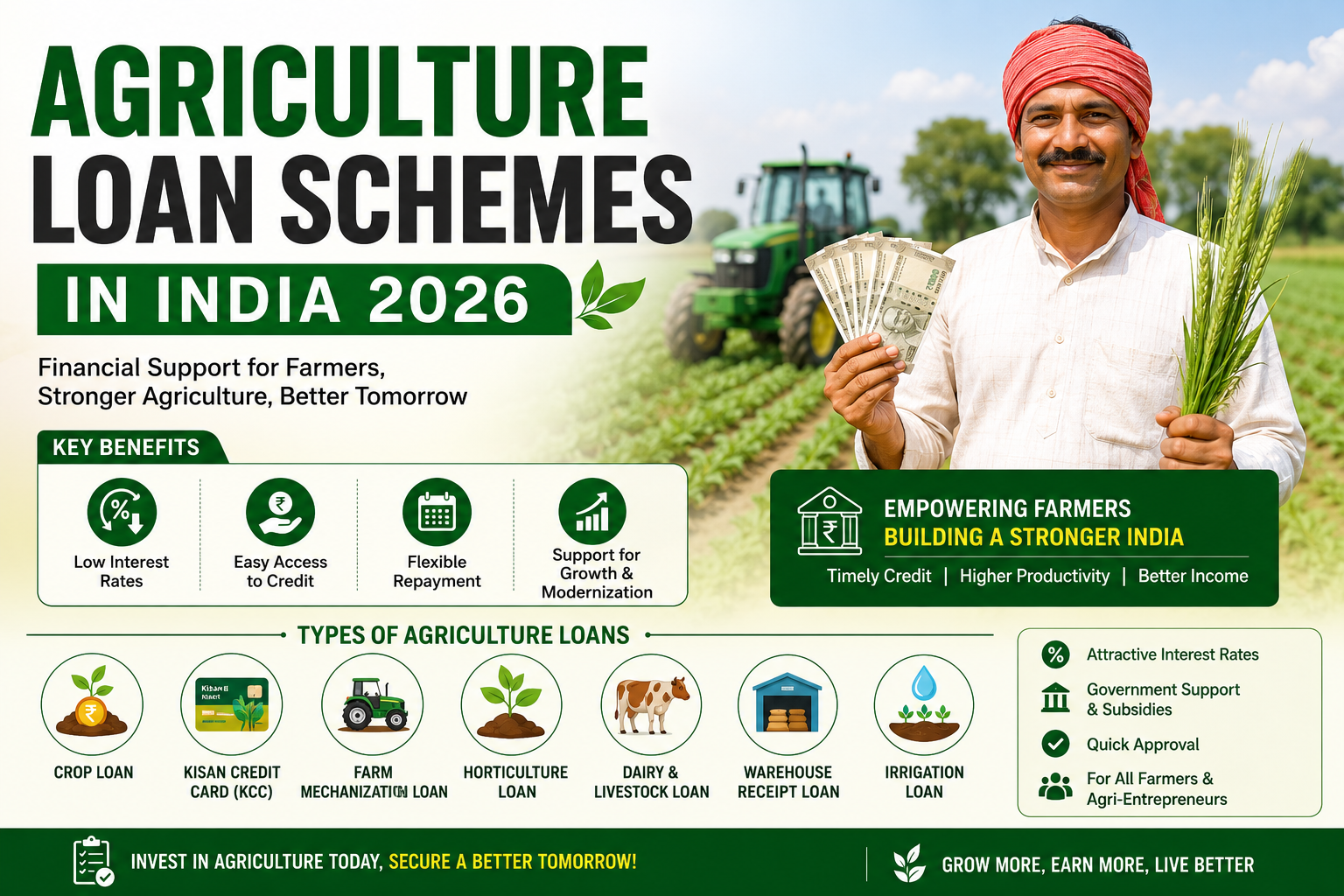
Agriculture loan schemes play a vital role in supporting farmers across India by providing financial assistance for farming activities, purchasing equipment, irrigation, livestock, and other agricultural needs. Whether you are a small farmer, a marginal farmer, or an agribusiness owner, choosing the right agriculture loan can help improve productivity and increase income.
In this guide, we’ll explore the different agriculture loan schemes in India, their benefits, eligibility criteria, required documents, and the application process.
What Are Agriculture Loan Schemes?
Agriculture loan schemes are financial assistance programs offered by banks, cooperative societies, regional rural banks, NBFCs, and government institutions. These loans help farmers meet short-term and long-term financial requirements related to agriculture.
The primary objective of these schemes is to improve agricultural production, support rural development, and reduce the financial burden on farmers.
Types of Agriculture Loan Schemes
1. Crop Loan
A crop loan helps farmers finance seasonal farming expenses such as purchasing seeds, fertilizers, pesticides, labor costs, and irrigation. These loans are usually short-term and are repaid after harvesting the crops.
Benefits:
- Low interest rates
- Quick approval process
- Flexible repayment after harvest
- Available for multiple crop seasons
2. Kisan Credit Card (KCC) Loan
The Kisan Credit Card (KCC) is one of India’s most popular agricultural financing schemes. It provides farmers with easy access to working capital for farming and allied activities.
Key Features:
- Revolving credit facility
- Affordable interest rates
- Flexible withdrawal options
- Coverage for crop cultivation and livestock
3. Farm Mechanization Loan
A farm mechanization loan helps farmers purchase tractors, harvesters, power tillers, irrigation pumps, and modern farming equipment.
These loans improve farming efficiency and reduce manual labor.
4. Horticulture Loan
Farmers involved in fruit cultivation, vegetable farming, floriculture, and plantation crops can apply for horticulture loans to develop orchards and modern irrigation systems.
5. Dairy and Livestock Loan
These agriculture loan schemes provide financial support for dairy farming, poultry farming, goat farming, sheep farming, fisheries, and animal husbandry.
The loan can be used to purchase livestock, construct sheds, and buy feed or equipment.
6. Warehouse Receipt Loan
Farmers can obtain a warehouse receipt loan by storing harvested crops in approved warehouses. Instead of selling immediately at lower prices, they can use stored produce as collateral to access funds.
Government Agriculture Loan Schemes
Several government-backed agriculture loan schemes aim to improve farmers’ access to affordable credit.
Kisan Credit Card Scheme
The Kisan Credit Card Scheme offers easy financing for crop production and allied agricultural activities. It simplifies the borrowing process and ensures timely availability of funds.
Agriculture Infrastructure Fund
This scheme supports investments in post-harvest management, storage facilities, cold chains, grading units, and processing infrastructure.
NABARD Refinance Support
The National Bank for Agriculture and Rural Development (NABARD) provides refinance support to banks, enabling them to offer agricultural loans at competitive interest rates.
Benefits of Agriculture Loan Schemes
Choosing the right agriculture loan scheme offers several advantages:
- Affordable interest rates
- Flexible repayment options
- Easy loan processing
- Financial support for crop production
- Purchase of modern farming equipment
- Investment in irrigation systems
- Support for dairy and livestock farming
- Improved agricultural productivity
- Government interest subsidies on eligible loans
Eligibility Criteria
Although eligibility may vary between lenders, applicants generally must meet the following conditions:
- Be an Indian citizen.
- Be engaged in farming or agricultural activities.
- Own agricultural land or have valid cultivation rights.
- Meet the lender’s age requirements.
- Have valid identity and address proof.
Documents Required
Applicants usually need the following documents:
- Aadhaar Card
- PAN Card
- Passport-size photographs
- Address proof
- Land ownership or lease documents
- Bank account details
- Income proof (if applicable)
- Crop or farming details
Additional documents may be required depending on the lender and loan type.
How to Apply for an Agriculture Loan
Applying for an agriculture loan is straightforward.
Step 1: Choose the Right Loan Scheme
Identify a loan that matches your farming needs, whether for crops, machinery, livestock, or irrigation.
Step 2: Compare Interest Rates
Compare different banks and financial institutions to find the best agriculture loan interest rate and repayment terms.
Step 3: Gather Documents
Prepare all required documents before submitting your application.
Step 4: Submit the Application
Visit your preferred bank branch or apply through its official online portal.
Step 5: Loan Verification
The lender verifies your documents, farming details, and eligibility.
Step 6: Loan Approval and Disbursement
Once approved, the loan amount is credited directly to your bank account.
Tips to Improve Agriculture Loan Approval
To increase your chances of approval:
- Maintain accurate land ownership records.
- Apply for the appropriate loan amount.
- Keep your bank account active.
- Repay previous loans on time.
- Submit complete and accurate documentation.
Conclusion
Agriculture loan schemes are an essential source of financial support for farmers and agribusinesses. Whether you need funds for crop cultivation, farm equipment, irrigation, dairy farming, or agricultural infrastructure, selecting the right agriculture loan can help you improve productivity and manage farming expenses effectively.
Before applying, compare loan options, understand the eligibility requirements, check interest rates, and ensure you have all the necessary documents. A well-planned agriculture loan scheme can provide the financial stability needed to grow your agricultural business and achieve long-term success.