
 By Rohan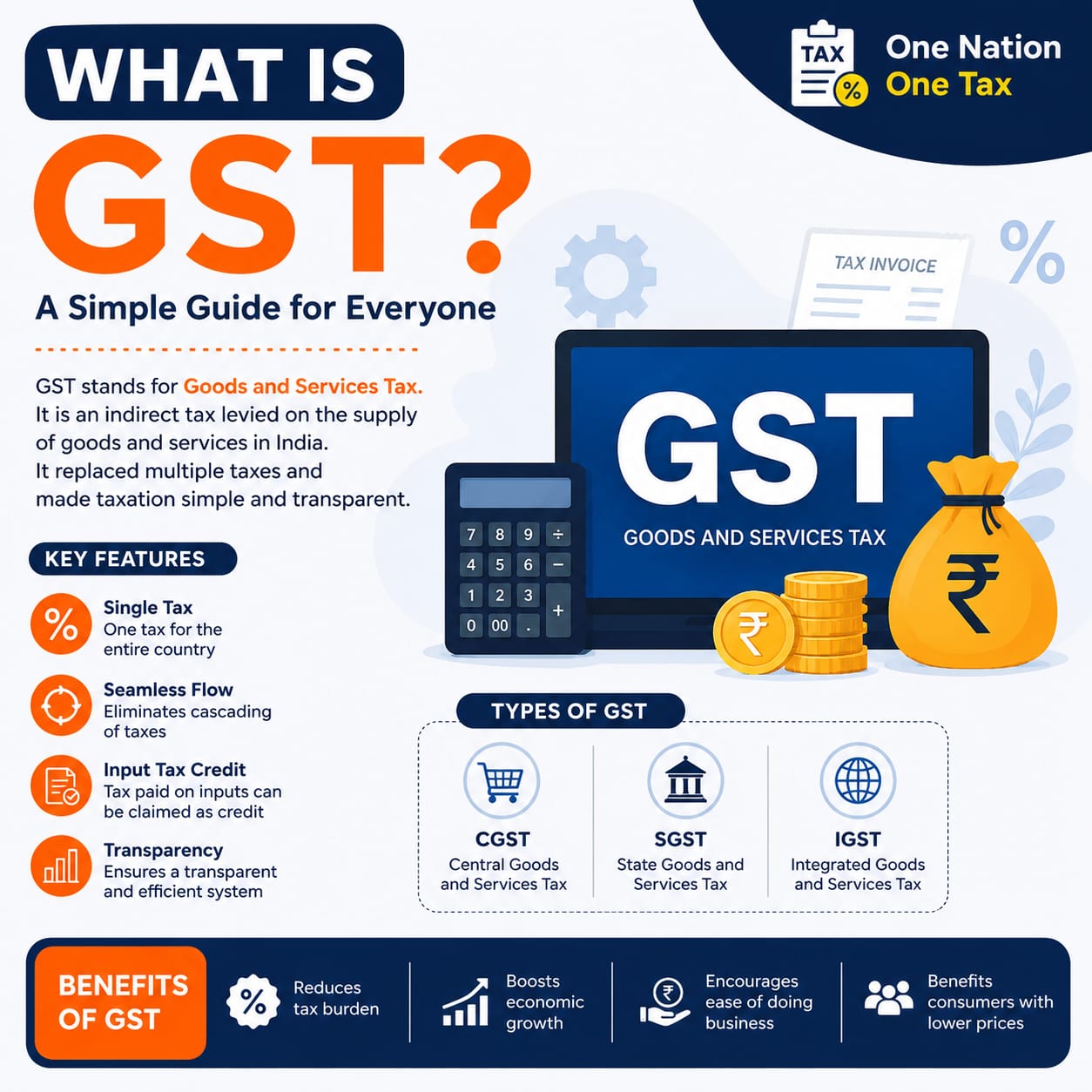
Introduction
The Goods and Services Tax (GST) is one of the most important tax reforms introduced in India. It started on 1 July 2017 to replace various indirect taxes like VAT, service tax, excise duty, and entry tax. Before GST, businesses had to follow different tax laws, which made the system complicated and time-consuming.
Now, GST has created a single tax structure that simplifies taxation, improves transparency, and makes it easier to manage. Whether you own a business, work as a freelancer, study, or shop, knowing what GST is can help you make smart financial choices and stay compliant with Indian tax laws.
What Is GST?
GST (Goods and Services Tax) is an indirect tax applied to the supply of goods and services. It uses a destination-based taxation system, meaning the tax is collected in the state where the goods or services are consumed, not where they are produced.
If you’re curious about what GST is and how it works, the process is straightforward. When a product or service is sold, GST is added to its selling price. The seller collects this tax from the buyer and pays it to the government. Registered businesses can also claim Input Tax Credit on eligible purchases, which lowers their overall tax bill.
History of GST in India
The idea of GST was first suggested in 2000, but after years of planning and discussions, it was officially put into action on 1 July 2017. The goal was to remove multiple indirect taxes and create a single tax system that benefits businesses, governments, and consumers.
Since its launch, GST has improved transparency, simplified compliance, and reduced the cascading effect of taxation.
Types of GST in India
India has four types of GST based on the nature of the transaction.
CGST (Central Goods and Services Tax)
- CGST is collected by the Central Government on transactions occurring within the same state.
SGST (State Goods and Services Tax)
- SGST is collected by the State Government on intra-state transactions.
IGST (Integrated Goods and Services Tax)
- IGST applies when goods or services are supplied from one state to another.
UTGST (Union Territory Goods and Services Tax)
- UTGST is imposed on transactions within Union Territories lacking their own legislature.
Understanding the types of GST in India helps businesses determine which tax applies to various transactions.
How Does GST Work?
To grasp what GST is and how it works, consider a simple example.
A manufacturer buys raw materials and pays GST on them. After producing finished goods, the manufacturer sells them to a wholesaler and charges GST. Since GST was already paid on the raw materials, the manufacturer can claim Input Tax Credit, ensuring tax is paid only on the value added.
This process reduces double taxation and creates a clearer tax system.
GST Tax Slabs in India
Different goods and services fall under different GST rates.
0% GST Rate
- Basic food items and essential goods.
5% GST Rate
- Essential household products and transportation services.
12% GST Rate
- Processed foods and selected consumer goods.
18% GST Rate
- Most professional services and commonly used products fall under this slab.
28% GST Rate
- Luxury products, premium automobiles, and some high-end consumer goods.
- Knowing the correct GST tax slab helps businesses calculate taxes accurately.
Benefits of GST
There are many benefits of GST for both small and large organizations.
Simplified Tax Structure
GST replaces multiple indirect taxes with one unified tax system.
Input Tax Credit
Businesses can lower their tax burden by claiming credit for eligible purchases.
Better Transparency
Every transaction is supported by a proper GST invoice, making tax reporting more precise.
Easier Business Expansion
Businesses can expand across India without having to navigate different state tax systems.
Online Compliance
Most processes, including GST registration, tax payments, and return filing, are handled online.
Who Should Register for GST?
Any eligible business should register for GST before collecting tax from customers.
Typically, businesses need registration if they:
- Cross the prescribed turnover limit.
- Supply goods or services across states.
- Sell products through e-commerce platforms.
- Want to claim Input Tax Credit.
Learning how to register for GST online helps new businesses start legally and avoid penalties.
GST Registration Process
Step 1: Visit the GST Portal
- Go to the official GST portal.
Step 2: Create an Account
- Register using your PAN and mobile number.
Step 3: Upload Documents
- Upload the required business documents and verify your information.
Step 4: Complete Verification
- Authenticate your application through OTP or Digital Signature Certificate.
Step 5: Receive GSTIN
- After successful verification, your GST Identification Number (GSTIN) will be issued.
- Today, registering for GST online has become easier because the entire process is digital.
GST Return Filing
Every registered taxpayer must file a GST return by the due dates.
The GST return filing process in India includes:
- Sales invoices
- Purchase invoices
- Tax collected
- Tax paid
- Input Tax Credit claimed
Filing a GST return on time helps businesses avoid penalties and stay compliant.
Input Tax Credit (ITC)
Input Tax Credit is one of the biggest benefits of GST.
It allows registered businesses to subtract the GST paid on business purchases from the GST collected on sales. This prevents multiple taxation on the same value and lowers operational costs.
Challenges of GST
While GST has simplified taxation, businesses still face some challenges.
Frequent Rule Changes
Businesses must stay updated with changing GST rules.
Compliance Requirements
Filing GST returns on time and keeping accurate records require good accounting systems.
Technical Issues
Sometimes businesses encounter difficulties using the GST portal.
Documentation
Keeping proper records of GST invoices is crucial for claiming Input Tax Credit.
Future of GST in India
The future of GST looks promising as the government continues to simplify tax compliance and improve digital services. New reforms are expected to make the GST return filing process in India faster, easier, and more efficient. Businesses that stay informed about GST regulations will keep benefiting from a transparent tax system.
Conclusion
Understanding why GST is important for every taxpayer in India. The introduction of GST has simplified indirect taxation, improved transparency, and established a unified tax system. Whether you’re learning about GST registration, filing a GST return, or exploring the benefits of GST for small businesses, having the right knowledge helps you remain compliant and make better financial choices.
Frequently Asked Questions (FAQs)
GST is an indirect tax charged on the supply of goods and services in India. It replaced multiple taxes with a single tax system, making tax collection simpler, reducing duplication, and improving transparency for businesses and consumers.
India has four types of GST: CGST, SGST, IGST, and UTGST. Understanding these types of GST helps businesses see which tax applies to different transactions and ensures accurate tax compliance.
Businesses that exceed the turnover limit, supply across states, sell on e-commerce platforms, and specific service providers should register for GST. Voluntary registration is also available for businesses that want to claim Input Tax Credit benefits.
Input Tax Credit allows registered businesses to lower their tax liability by claiming credit for GST paid on business purchases. This makes GST more efficient by eliminating the cascading effect of taxes.
The GST return filing process in India is done online through the GST portal. Businesses report their sales, purchases, taxes collected, and Input Tax Credit while submitting returns before the deadline to avoid penalties.
GST simplifies taxation, supports online compliance, allows Input Tax Credit, improves transparency, and facilitates smoother interstate trade. These advantages show the benefits of GST for small businesses and promote long-term growth.
 Keshav Kaushik